Master Clean Chord Changes
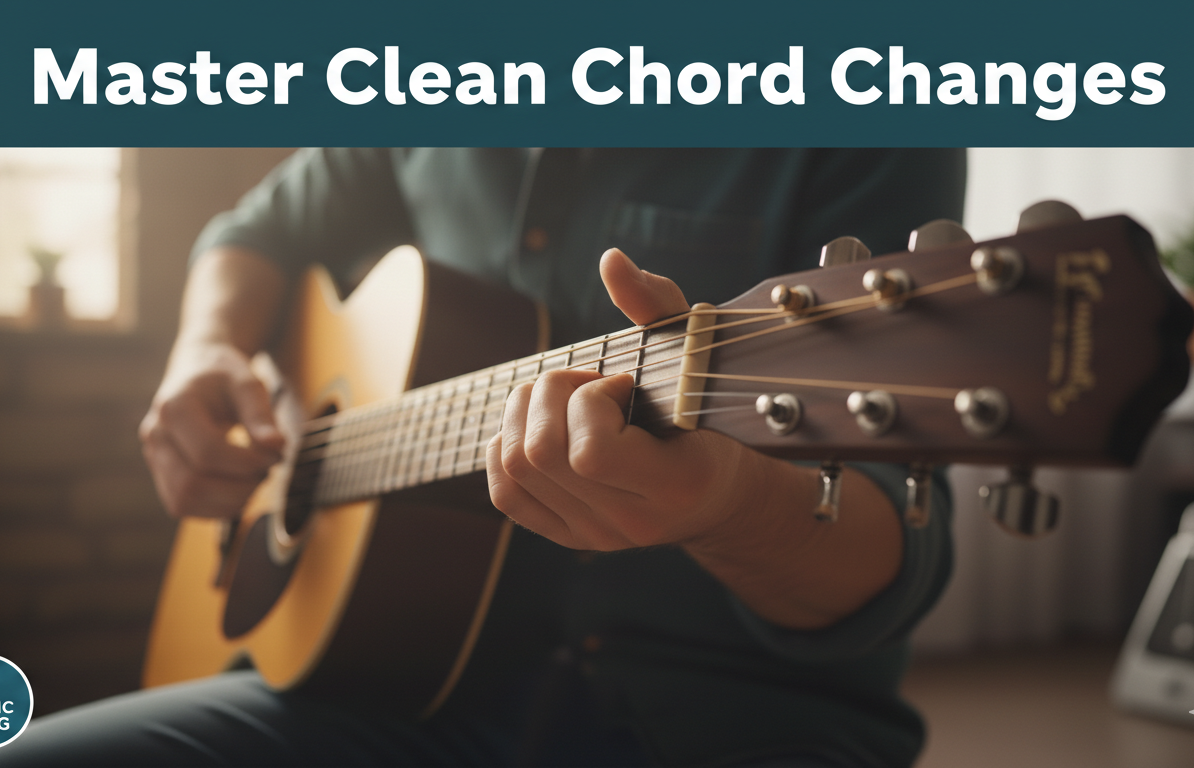
Most beginners know chords, but they can’t move between them smoothly. That’s exactly what separates intermediates from beginners.
What to do
Practice switching between your “big four” chords: G – C – D – Em.
Use a timer. Aim for 0.5 seconds or less between chord shapes.
Strum down once every change, not fast, just clean.
Why it matters
Clean transitions make your rhythm sound professional, even on simple songs.
Once this locks in, harder songs open up instantly.
2. Improve Your Strumming Patterns Using Real Songs
Beginner players often repeat the same down-down-up-up-down-up pattern. That creates a ceiling.
Try this
Learn at least five new strumming patterns, including:
Shuffle
Calypso
Pop rock ballad pattern
Straight 8ths
Swing 8ths
Pro tip from lessons I’ve taught
Record yourself. When you hear your strumming, you’ll instantly know what feels robotic.
Because rhythm is the first thing listeners notice, upgrading your strumming improves your entire sound.
3. Start Learning Barre Chords (Slowly… not aggressively)
Barre chords separate beginner and intermediate guitarists instantly.
Start simple
F major (mini barre version first)
B minor
G major (E-shape barre)
Training routine
Hold the shape for 10 seconds
Release
Repeat 10 times
No rushing. Good barre chords require hand strength and muscle memory.
4. Add Scales & Lead Techniques to Your Practice Plan
Intermediates don’t just strum chords; they can also play riffs, solos, and melody lines.
Learn these first:
Pentatonic scale (Minor + Major)
Alternate picking
Hammer-ons & pull-offs
Slides
Bends (¼, ½, whole step)
These techniques give you the freedom to improvise and play lead guitar confidently.
5. Start Reading Tabs Faster & More Accurately
If chords are the “language,” tabs are the “map.”
How to improve quickly:
Open your favorite song on guitar tabs
Play 4–6 measures at a time
Loop them until smooth
Only then move forward
Tabs help you learn riffs and solos, which are essential for intermediate players.
6. Expand Your Chord Library Beyond the Basics
Intermediates don’t stop at open chords.
Add these to your toolbox:
7th chords (G7, A7, B7)
sus2 / sus4
add9 chords
minor 7 chords
These chords add color and musical personality to your playing. You’ll instantly sound more advanced even on simple songs.
7. Practice With Backing Tracks (Game-changing Step)
In my experience, this is where students truly start to think like musicians.
Why backing tracks help:
They force a consistent rhythm
Improve timing
Build improvisation skills
Make practice addictive (seriously)
Start with slow 70–80 BPM backing tracks. Then gradually ramp up.
8. Learn Entire Songs, Not Just Intros
Beginners famously learn intros… and stop.
Intermediates finish the whole song.
Song structure checklist:
Intro
Verse
Chorus
Bridge
Outro
Finishing full songs builds endurance, musical awareness, and confidence.
9. Create a Consistent Practice Routine (20–30 Minutes Daily)
You don’t need 2 hours a day just a plan.
Suggested daily routine:
5 minutes – Warmup + finger exercises
10 minutes – Chords + transitions
10 minutes – Scales + lead practice
5 minutes – Song work or improvisation
Small, consistent practice beats occasional long sessions every time.
10. Get Feedback From a Teacher or Online School
When students get stuck, it’s usually because they’ve developed a few bad habits without realizing it.
A qualified instructor fixes those instantly.
Zoom Twin Cities (ZTC) guitar teachers help beginners:
Improve technique
Build confidence
Learn songs faster
Develop proper finger placement
Create a structured practice plan
You’ll progress faster in 3 months of guided lessons than 1 year of self-teaching.
Final Thoughts
Transitioning from beginner to intermediate guitar is completely achievable if you follow a structured plan. Focus on cleaner chords, better rhythm, new techniques, and consistent practice. Teaching guitarists at this stage, the breakthrough always comes after they upgrade their fundamentals and challenge themselves with new musical skills.
If you're ready to level up and want professional coaching, Zoom Twin Cities Music School is a great place to grow faster with guided lessons