Why Guitar Is the Perfect First Instrument for Teens and Adults
Make it stand out
Whatever it is, the way you tell your story online can make all the difference.
It should not be confusing when deciding on the choice of your first instrument. It makes the guitar a perfect choice among teenagers and adults alike due to the fact that it allows you to learn how to play guitar in a fast manner, play songs you love, and get to know music styles.
Simple chords in the early stages of a guitar class make you learn the basics of music and have a good time practicing. In case of one-on-one guitar training or online guitar training, you may learn the guitar at your own pace, gain confidence, and even prepare yourself to perform with the guitar.
One of the best skills you can learn at any age is learning how to play the guitar. It is beginner-friendly, satisfying, and a lifelong musical experience, whether you are a teenager seeking an artistic outlet or an adult learning to play the guitar as a new hobby.
What makes the guitar a great first instrument for teens and adults?
1. Easy to Start, Fun to Progress
You can learn basic chords and strum simple tunes within just a few weeks. This quick progress keeps you motivated and excited to keep practicing.
2. Fits Many Musical Styles
From jazz piano-inspired melodies to rock, pop, and folk, the guitar adapts to almost any genre you enjoy. This flexibility means you can play your favorite songs without switching instruments.
3. Portable and Affordable
Unlike large instruments, a guitar is easy to carry and store, making it perfect for lessons, jam sessions, or travel. You can also start with an affordable beginner model and upgrade as your skills grow.
4. Boosts Creativity and Confidence
Playing guitar encourages you to write your own music, improvise, and explore new learning styles. Over time, these creative wins build self-confidence that extends beyond music.
5. Connects You with a Community
From casual jam circles to formal music education settings, guitar players often find it easy to connect with others. These shared experiences make the journey even more rewarding.
How hard is it to learn basic guitar chords?
One of the most popular reasons that many people give to excuse themselves from learning about the basic guitar chords is that it is difficult.
Most players who do put some practice in can anticipate that in the first week, with a 15-20 minute per day practice time, they will play their first three to five chords (such as G, C, D, Em, and A). Changing chords easily, finger strain, and soreness of the finger tips are the challenges in most cases.
Here’s a rough timeline based on consistent practice:
First few days – You’ll learn chord shapes and get used to pressing the strings without muting others
1–2 weeks – You’ll start switching between two or three chords without pausing too much.
3–4 weeks – You’ll be able to play simple songs using only basic chords and strumming patterns.
The real key? Daily short practice sessions instead of long, irregular ones. Your fingers adapt faster that way, and muscle memory starts kicking in.
Can I use a guitar for classical, pop, or jazz music?
Absolutely? You can use the guitar in classical and pop music, and yes, jazz too, but the phrasing, style in playing, technique, and even the kind of guitar you play are different depending on the style.
Here it is broken down:
Classical - Generally hosted on a nylon-string classical guitar and fingered. Reading standard notation, playing arpeggios, and attention to tone and dynamics are some of the things associated with music.
Pop- It does not matter what type of guitar (acoustic or electric) you will take. Pop frequently depends on easy chords, rhythmical strumming, and catchy riffs. It doesn’t matter how advanced the theory is; using chord shapes and timing are your best friends here.
Jazz - Usually done on electric or hollow-body guitars, but an acoustic will work. Jazz employs long chords (such as 7ths, 9ths, 13ths), complicated progressions, and extemporization.
It is the one that incorporates more theory as compared to the other two, and so, you will need to study chord voicings and scales.
The good thing is that much of guitar skills overlaps. With chord shapes, rhythm, and ear training under your belt, you can adjust to any of these styles with time.
How soon can you play your favorite songs on guitar?
In a few weeks, you could start playing simplified versions of your favorite songs, so long as you practice regularly during the beginner's guitar practice session.
Start out learning some basic chords and strum options, as it will help you to learn to play actual songs in a jiffy. Doing this, you will eventually learning to play along with tunes you love on piano/guitar, as you learn more and more complex chords and riffs.
To learn how to play the guitar, it is easier when selecting your favorite songs, thus entertaining you even during practice.
What are the long-term benefits of learning guitar?
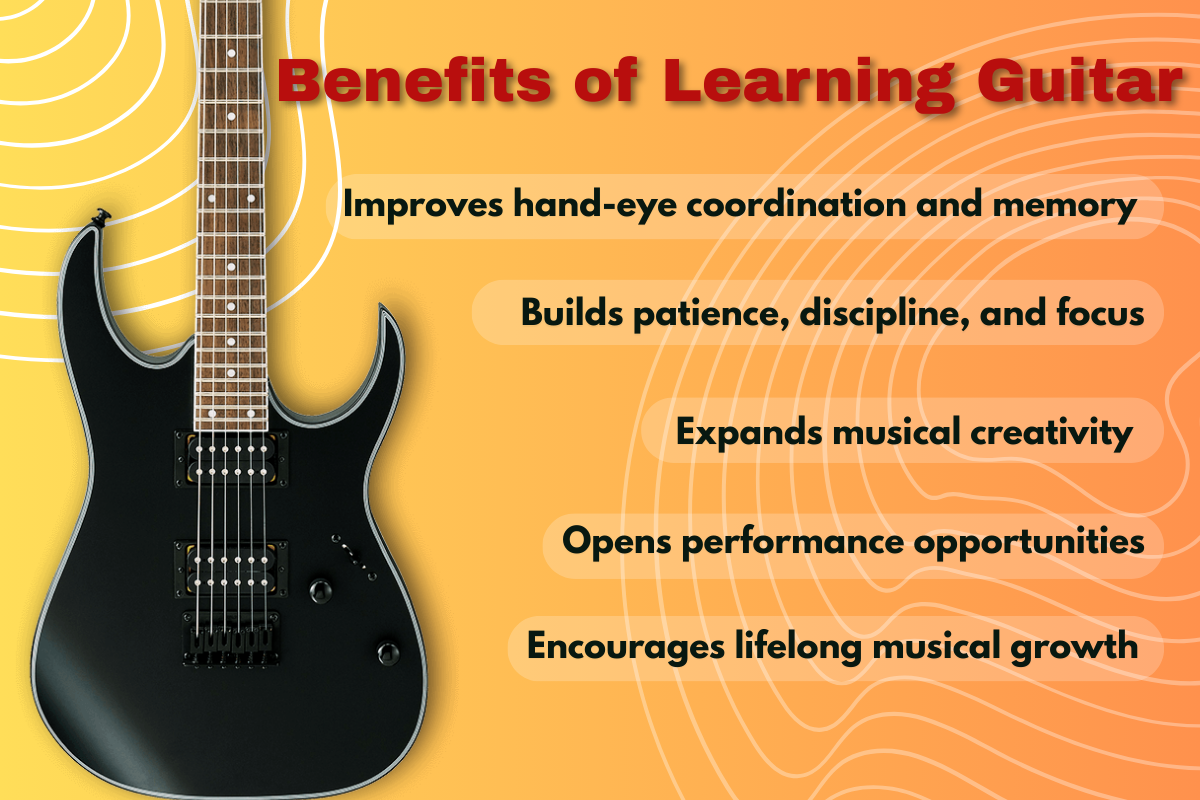
Improves hand-eye coordination and memory:
When you practice chords and finger positions, you’re not just learning to play your favorite song; you’re also strengthening your brain. This helps you learn music faster, remember patterns, and improve overall focus in other activities, too.
Builds patience, discipline, and focus:
Regular sessions, whether through piano lessons online or guitar practice, teach you to stick with challenging pieces. Over time, this develops habits that make it easier to stay motivated, handle mistakes, and push through difficult learning moments.
Expands musical creativity:
Exploring different musical styles lets you experiment with new techniques and helps you learn how to play more complex songs. You’ll gain skills for improvisation, creating your own melodies, and even composing original music.
Opens performance opportunities:
Practicing consistently prepares you for guitar gigs. Performing in front of others builds confidence, helps you express yourself, and teaches you how to stay calm under pressure.
Encourages lifelong musical growth:
Learning to play your favorite songs and taking on new challenges keeps your passion alive. It promotes creativity, brain activity, and a lifelong love of music, whether through ongoing private guitar lessons or solo practice at home.
Take Your First Lesson at Zoom Twin Cities
How do I start learning guitar? Prepared to make your dream of playing the guitar a reality? It's simpler to begin than you would suppose. With Zoom Twin Cities, you can book a first lesson and start learning your favorite songs, practicing chords, and trying out anything you desire to explore in music.
Don’t hesitate, grab your guitar today, and begin your path to self-assured piano performing or guitar virtuosity.
Book your first lesson today and start playing your favorite songs from day one.