How to Play Drums for Beginners: First Lesson Guide For Learning
So you are keen to learn drums in Minneapolis or anywhere in the Twin Cities. Honestly, great choice.
Drums are one of the most beginner-friendly instruments out there. No complicated music theory. No awkward finger positions. Just rhythm, sticks, and a little bit of daily practice. And the benefits go beyond music drumming is also one of the best ways to relieve stress. Here's Why Learning Drums Is One of the Best Ways for Minneapolis Families to Relieve Stress.
By the end of this guide, you'll know exactly how to hold drumsticks, play your first real beat, and follow a simple practice plan that works whether you're a kid or an adult starting from zero.
Quick View
| Section | What You'll Learn |
|---|---|
| What You Need | Gear options and costs |
| Essential Skills | Grip, timing, rudiments |
| First Beat | The basic rock beat step-by-step |
| Easy Songs | What to play first |
| Practice Routine | Weekly plan for beginners |
| Common Mistakes | 5 errors and how to fix them |
| Lessons Near You | Twin Cities drum lesson locations |
What Do You Need to Get Started?
Many beginners think they need a full acoustic kit before they can learn anything. That's not true. Honestly, a pair of drumsticks and a practice pad is enough to start building real timing and stick control. That combo costs less than $30 and gets you further than most people expect. Here's how your options compare:
| Option | Cost | Noise Level | Best For |
|---|---|---|---|
| Practice Pad + Sticks | Low | Very quiet | Absolute beginners |
| Electronic Drum Kit | Medium | Quiet (headphones) | Home learners |
| Acoustic Drum Kit | High | Loud | Studio or dedicated space |
Verdict: Start with sticks and a pad. Only upgrade when you're practicing consistently. Buying a full kit before you've built the habit is just an expensive way to acquire furniture.
When you are ready to set one up, here's How to Set Up a Drum Kit A Step-by-Step Beginner-Friendly Guide
Essential Beginner Skills You Must Build First
To improve quickly, beginners need to focus on a few core things: holding drumsticks properly, keeping steady timing, learning simple drum patterns, and practicing basic rudiments. These skills are the foundation. Without them, progress is slow. With them, everything works better whether you're 8 or 48.
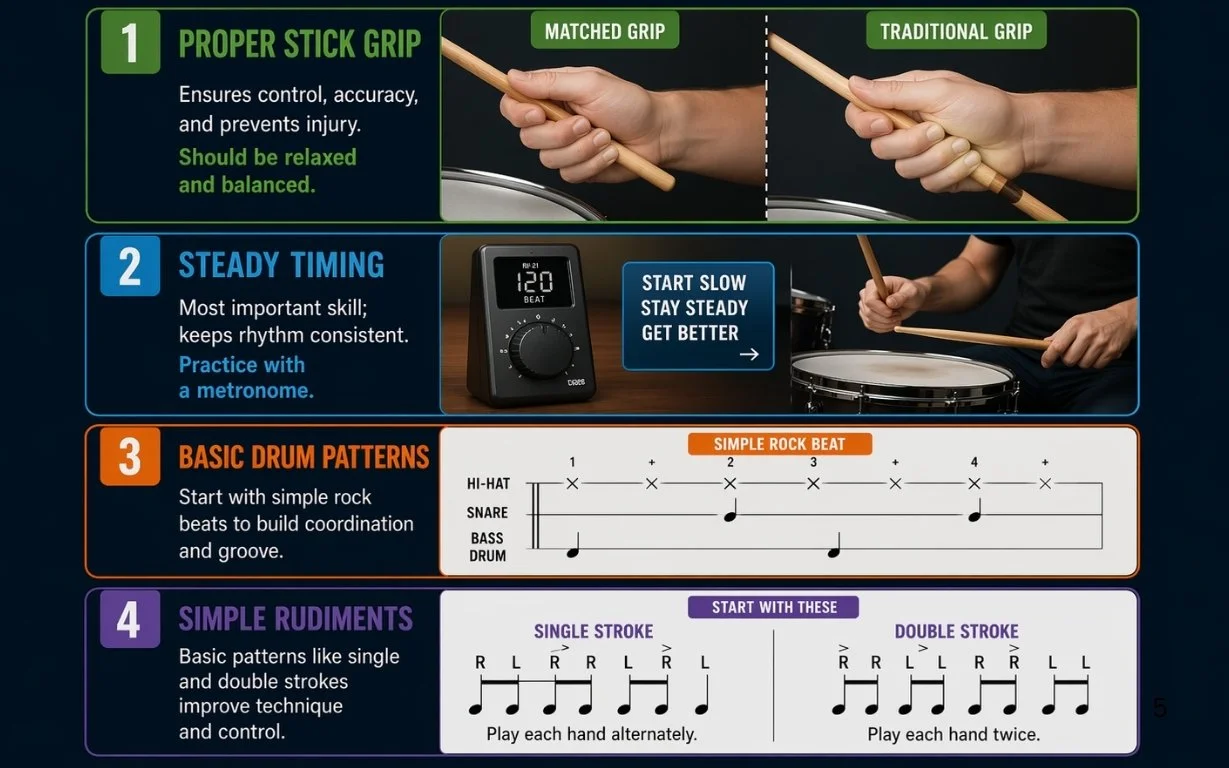
Core drumming skills for beginners:
Proper stick grip: Ensures control, accuracy, and prevents injury. Should be relaxed and balanced.
Steady timing: Most important skill; keeps rhythm consistent. Practice with a metronome.
Basic drum patterns: Start with simple rock beats to build coordination and groove.
Simple rudiments: Basic patterns like single and double strokes improve technique and control.
How to Hold Your Drumsticks?
Matched grip is the easiest and most natural way to start. Both hands hold the stick the same way palms facing down.
Here's how to do it in a few steps:
Hold the stick between your thumb and index finger, about a third of the way up from the bottom end
Find the balance point this is where the stick bounces on its own naturally
Wrap your remaining fingers loosely around the stick
Use your wrist to move the stick up and down, not your whole arm
The most common beginner mistake is gripping too tight. Relax your hands. A loose, controlled grip gives you better bounce, less wrist tension, and more control over time.
Play Your First Beat: The Basic Rock Beat
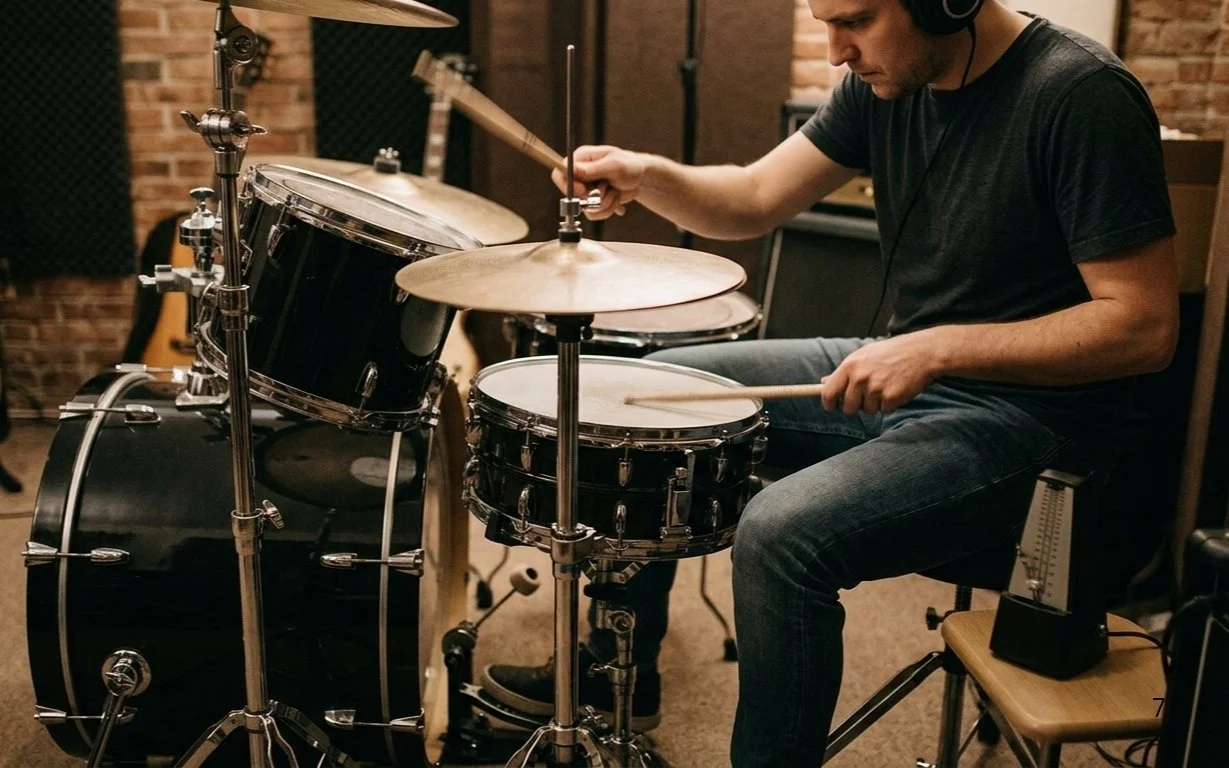
This beat is the one. The beat that opens up everything.
The basic rock beat uses three parts of the kit together: the hi-hat, the snare drum, and the bass drum. Get this rhythm down and you can play along with hundreds of real songs.
Hi-Hat Pattern
Your right hand plays the hi-hat on every eighth note. Count out loud as you play:
1 and 2 and 3 and 4 and
Every single count, including all the ands, gets a hi-hat hit. Keep it steady and even. This is the pulse that holds everything together.
Add Snare on 2 & 4
Now add your left hand hitting the snare drum only on beats 2 and 4.
Count it out:
Hi-hat on every count: 1 and 2 and 3 and 4 and
The snare lands right on the 2 and the 4
Add Bass Drum on 1 & 3
Use your right foot to press the bass drum pedal on beats 1 and 3.
Now you've got all three parts working together. That's the basic rock beat.
Combine Everything at 60 BPM
Start way slower than you think you need to. Set a metronome or drum app to 60 BPM and play through the whole pattern.
Slow and steady builds muscle memory. Rushing early just builds sloppy habits that are hard to fix later.
Want help with this beat in real time? Our instructors at Zoom Twin Cities walk you through it step by step online or in our Minneapolis studio. Book your first lesson here
Easy Songs to Start Playing
Once the basic rock beat feels natural, you're already ready for real music. No joke. Some great starting points for beginner drummers are slow rock songs, classic pop tracks, and anything with a steady 4/4 groove. If you're not sure where to start, ask your instructor they'll match songs to your taste and skill level
Recommended Tracks for Beginners
If you can play the basic rock beat, you can already play along with these popular songs. Remember: start slow, stay in time, and actually enjoy it. That is the whole point.
"Seven Nation Army" – The White Stripes: The ultimate beginner track. It’s consistent, punchy, and the tempo is very forgiving.
"Yellow" – Coldplay: A great choice for practicing dynamics and keeping a steady, moderate tempo without getting overwhelmed by complex fills.
"Billie Jean" – Michael Jackson: This is an excellent exercise in maintaining a strict, danceable groove that doesn't deviate.
"Boulevard of Broken Dreams" – Green Day: A perfect example of a steady, mid-tempo rock beat that allows you to focus on your limb independence.
"Back in Black" – AC/DC: While the intensity is higher, the drum pattern is iconic, repetitive, and excellent for developing rock-solid timing.
Pro-Tip: If you feel like you are struggling with a specific transition, don't play the whole song. Loop just the first 30 seconds until you can play it perfectly in time with the track. Once you’ve nailed the groove, the rest of the song will feel much easier to manage
Simple Practice Routine for Beginners
Consistency is what builds drumming skills. Short daily sessions create muscle memory and habits. Long irregular sessions don't. Build the routine early, and everything else gets easier.
| Timeframe | Focus | Goal |
|---|---|---|
| Week 1–2 | Stick grip + basic rock beat | Build control and steady timing |
| Week 3–4 | Add simple songs + patterns | Improve hand-and-foot coordination |
| Ongoing | Rudiments + repetition | Build confidence and start increasing speed |
Stick with this and you'll feel real progress within the first month. That's not hype it's just how consistent practice works.
For a full breakdown on making the most of short sessions, read How to Practice Any Musical Instrument Effectively in Just 30 Minutes a Day
How to Practice Drums Quietly at Home?
Noise is a real problem for many beginners. Apartments, neighbors, late nights it matters.
Good news, you've got options.
Practice pad the cheapest and most portable way to practice stick control silently
Electronic drum kit with headphones: the best home setup, sounds great and disturbs nobody
Soft surfaces even practicing strokes on a pillow or folded towel builds real stick control
Tip: Even a pillow works. Seriously. Practicing single strokes on a pillow for 10 minutes a day builds wrist strength and control faster than most people expect.
Curious about home setups? Check out our full breakdown: Electronic Drum Kits vs. Acoustic Drums: Which Is Better for Home Practice?
Ready to Take Your Drumming to the Next Level?
Don't just practice, play with purpose. At Zoom Twin Cities - Music Schools, our expert instructors specialize in tailoring lessons to your unique musical taste and skill level. Whether you are struggling to keep the beat or ready to master your first complex fill, we provide the personalized guidance you need to succeed.
Book Your Trial Lesson Today at Zoom Twin Cities Music Schools
5 Beginner Mistakes to Avoid While Playing Drums
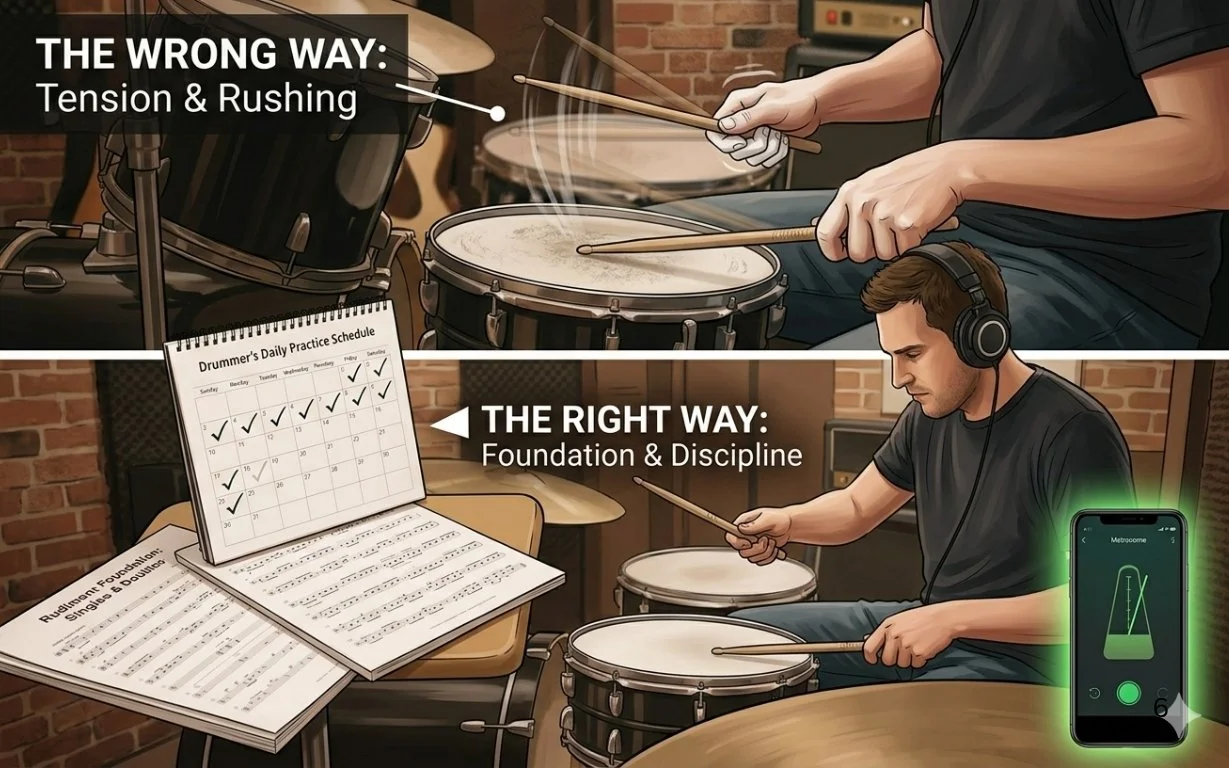
These are the things that slow most beginners down. Easy to fix once you know about them.
Skipping the metronome Fix: Always practice with steady timing. A free metronome app works fine. Timing is the number one skill in drumming.
Playing too fast too soon Fix: Start slow. Like, it feels slower than comfortable. Speed is a result of clean, slow repetition, not the other way around.
Holding sticks too tightFix: Relax your grip. Tension in your hands kills bounce, slows you down, and can hurt your wrists over time.
No practice schedule Fix: Practice daily, even if it's just 15 minutes. Consistency beats marathon sessions every single time.
Ignoring rudiments Fix: Practice basics like single strokes and double strokes regularly. They're boring at first, but they're the foundation of everything.
Can You Learn Drums Without a Teacher?
Yes, you can learn using YouTube videos and apps. Many people do this and make decent progress. But here's the honest reality: most beginners who go solo end up building terrible habits they don't even notice. Things like grip problems, tension in the wrists, poor posture, and timing issues. These get harder to fix the longer they go uncorrected. A good teacher catches all of these issues in the first lesson or two. That's months of frustration saved right there.
Simple truth: Learning alone works, but learning with guidance works faster and builds better habits from the start. That's why so many Twin Cities students take Zoom drum lessons same expert instruction, no commute required.
Beginner Drum Lessons in the Twin Cities
If you want to make faster progress and learn proper technique from day one, working with a real instructor is much more effective. Our beginner-friendlydrum lessons guide both kids and adults step-by-step, at your pace, with no experience needed. We offer lessons in the following: Minneapolis, Edina, Eden PrairieMaple Grove, and Wayzata. St. Paul, Shakopee, St. Louis Park
Our drum instructors have years of teaching experience working with kids, teens, and adult beginners. Every lesson is built around your pace, your goals, and your favorite music, not a rigid curriculum.
Plus, online Zoom Twin Cities drum lessons offer the same quality instruction from anywhere in Minnesota.
Ready to turn beats into real music? Book your first lesson at Zoom Twin Cities
Final Thoughts
Drumming is one of those instruments where the basics take you pretty far, pretty fast. Start simple. Get your grip right. Learn the basic rock beat. Practice a little every day. That's genuinely the whole plan for month one.
Don't wait until you have the perfect kit or the perfect setup. Just start. And if you want expert guidance from day one with instructors who actually make it enjoyable, Zoom Twin Cities is ready when you are. Book your first drum lesson today spots fill fast
FAQs
-
Yes, drums are easy to start. Most beginners can learn simple beats within a few days of practice. The basic rock beat is something almost anyone can get in their first week.
-
Yes, adults can learn drums at any age with regular practice. It's never too late we teach adult beginners all the time at Zoom Twin Cities.
-
Kids can start as early as 6–7 years old with beginner-friendly lessons. At that age, shorter sessions focused on fun and basic rhythm work really well.
-
No. A practice pad and sticks are completely enough in the beginning. Save the bigger investment for once you're practicing consistently.
-
20–30 minutes daily is plenty for steady progress as a beginner. Short and consistent always beats long and irregular.
-
The basic rock beat is a hi-hat on every eighth note, a snare on beats 2 and 4, bass drum on beats 1 and 3. It's simple, it's useful, and it's the foundation of most popular music you already know. It's the most useful beat you'll ever learn.
-
Yes, many beginners start at home using online lessons and a practice pad or electronic kit. Our Zoom drum lessons make it easy to get proper instruction from anywhere.
-
Yes, they're actually great for beginners, quiet enough for home use, and responsive enough to build real technique. Read more: Electronic Drum Kits vs. Acoustic Drums.