What are the Proven Benefits of Piano Lessons for Children?
The proven benefits of piano lessons for children backed by research go far beyond hitting the right notes. They touch brain development, emotional health, academic performance, and lifelong confidence.
A 2013 study published in PLOS ONE found that even a few months of music training significantly improved children's brain connectivity, particularly in areas linked to language processing and memory. That's not a small finding. That's a structural change in how a child's brain organizes information.
If you're a parent in Minnesota trying to decide whether music lessons are worth the time and money, here's the honest answer: you're not just paying for music. You're investing in a sharper, calmer, more confident kid, and the science backs that up completely.
Quick Summary
Piano doesn't just teach kids to play songs. It changes how they think, focus, and handle the world around them.
The benefits of piano lessons:
Memory: trains muscle memory, working memory, pattern recall
Focus: practice builds attention that carries into school
Academics: stronger in math, reading, and problem-solving
Confidence: small wins stack into real self-belief
Emotional growth: stress relief, patience, regulation
Creativity: improvisation trains creative thinking
Discipline: daily practice = life skill, not just music skill
Help your child build confidence, creativity, and a lifelong love for music. Zoom Twin Cities offers fun, flexible, personalized at-home and in-studio music lessons for kids and adults across Minneapolis and the Suburbs. Book a lesson today and let the music journey begin.
Why Is Piano One of the Best Instruments for Children?
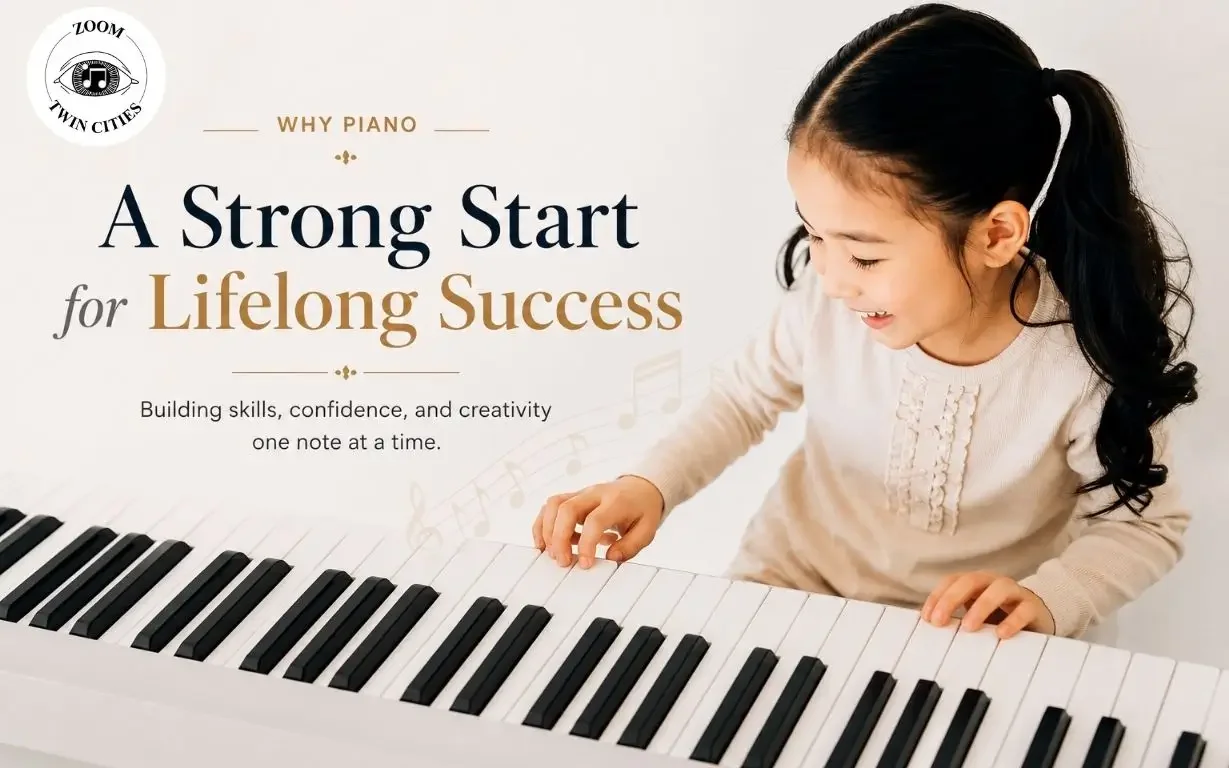
Piano has a reputation as the perfect first instrument, and it earns that reputation for a simple reason: the layout explains itself.
Every note has one key. The keyboard is visual, linear, and logical. A child can look at it and start to understand how music is organized before they can even read a single note on a staff. That clarity removes a huge barrier to early learning.
Piano also builds the kind of musical foundation that travels. A child who learns piano first picks up guitar, violin, or drums with a real head start because they already understand melody, timing, and harmony. They're not starting from zero. They're translating.
Top 7 Proven Benefits of Piano Lessons for Children
Piano lessons reach well beyond the keys. Research consistently shows that children who study piano develop stronger memory, sharper focus, better academic performance, healthier emotional habits, greater creativity, real discipline, and genuine self-confidence. These aren't soft outcomes. They show up in classrooms, in friendships, and in how kids handle hard things. Here are the top 7 proven benefits:
1. Piano Lessons Improve Memory
Every time a child sits at the piano, they're exercising multiple types of memory at once.
Muscle memory forms as fingers learn patterns and chord shapes automatically
Working memory strengthens as children hold notes, rhythms, and dynamics in mind simultaneously
Pattern recognition improves as they identify and remember recurring musical structures
A study from Northwestern University found that children who received music training showed stronger auditory memory and faster recall than peers without musical training. This kind of memory training shows up in the classroom, in test-taking, and in day-to-day learning.
2. Piano Lessons Improve Focus and Attention
Piano gives you instant, honest feedback. If you lose focus, it sounds wrong. That's not a harsh environment, it's actually one of the most effective focus-training tools a child can have.
Children who take piano lessons learn to
Block out distractions during practice
Sustain listening attention for extended periods
Follow multi-step instructions without losing track
The structured, repetitive nature of piano practice builds focus as a habit, not just a skill.
3. Piano Lessons Support Better Academic Performance
The research linking music education to academic performance is among the most consistent in child development science. Piano, specifically, trains skills that show up directly in school:
Math: Reading sheet music involves fractions, counting, and pattern recognition
Reading: Music training strengthens phonological awareness, a core skill for literacy
Problem-solving: Working through a difficult passage teaches children to break problems into smaller steps
Listening comprehension: Piano sharpens auditory processing, which supports how children absorb classroom instruction
A 2006 study by E. Glenn Schellenberg at the University of Toronto found that children who received music lessons showed significantly greater IQ gains compared to control groups across verbal, mathematical, and cognitive domains.
4. Piano Lessons Build Confidence
Every piano teacher knows the moment. A child plays a song all the way through without stopping for the first time. It doesn't matter whether it's "Twinkle Twinkle" or a Mozart piece. The look on their face is always the same.
I did that.
Piano creates a constant cycle of small wins:
Learning a new note
Mastering a tricky section
Performing for family or in a recital
Recovering from a mistake and continuing anyway
Month after month, those experiences compound into something that's hard to manufacture any other way, genuine self-belief. The kind that doesn't disappear when things get hard
Ready to give your child the joy of learning music in a fun and supportive way? Book a personalized lesson with Zoom Twin Cities today and let their music journey begin.
5. Piano Lessons Encourage Emotional Growth
Young children feel things they don't always have words for. Piano gives them another way to get those feelings out.
Children who study piano regularly:
Learn to express themselves through sound and dynamics
Develop patience as they work through difficult passages
Experience the calming effect of a focused, repetitive activity
Build emotional regulation by learning to manage frustration constructively
The physiological effects are real too. Research links music-making to lower cortisol levels and activation of the brain's reward system.
6. Piano Lessons Increase Creativity
Reading music is only part of what piano teaches. The other part is learning to use it as a voice.
As children advance, they start improvising. They experiment with how a melody feels completely different played softly versus loudly, or slowly versus at full tempo. They try things that might not work. They discover that the same notes can communicate completely different emotions depending on how they're played.
Piano builds:
Musical imagination: Hearing a piece differently each time and finding new ways to interpret it
Creative risk-taking: Trying something new even if it might not work
Expressive thinking: Understanding that the same "correct" notes can communicate very different emotions depending on how they're played
These creative skills extend into writing, drawing, problem-solving, and how children approach any open-ended challenge.
7. Piano Lessons Teach Discipline and Patience
No child sounds good at piano on day one. Progress is gradual, measurable, and earned, and that's exactly why piano is one of the best teachers of discipline available to children.
Regular piano practice builds:
Consistent routines: Sitting down and doing the work even when it's hard
Delayed gratification: Understanding that effort today produces results tomorrow
Goal-setting: Working toward specific milestones, one piece or skill at a time
Time management: Fitting practice into a daily schedule
These aren't just music skills. They're habits that make children better students, better athletes, and eventually, better professionals.
Give your child the chance to grow with confidence, creativity, and lifelong skills through personalized lessons atZoom Twin Cities. Book a fun at-home or in-studio music lesson today and help them unlock their full potential through music.
The Science Behind Piano Lessons and Brain Development
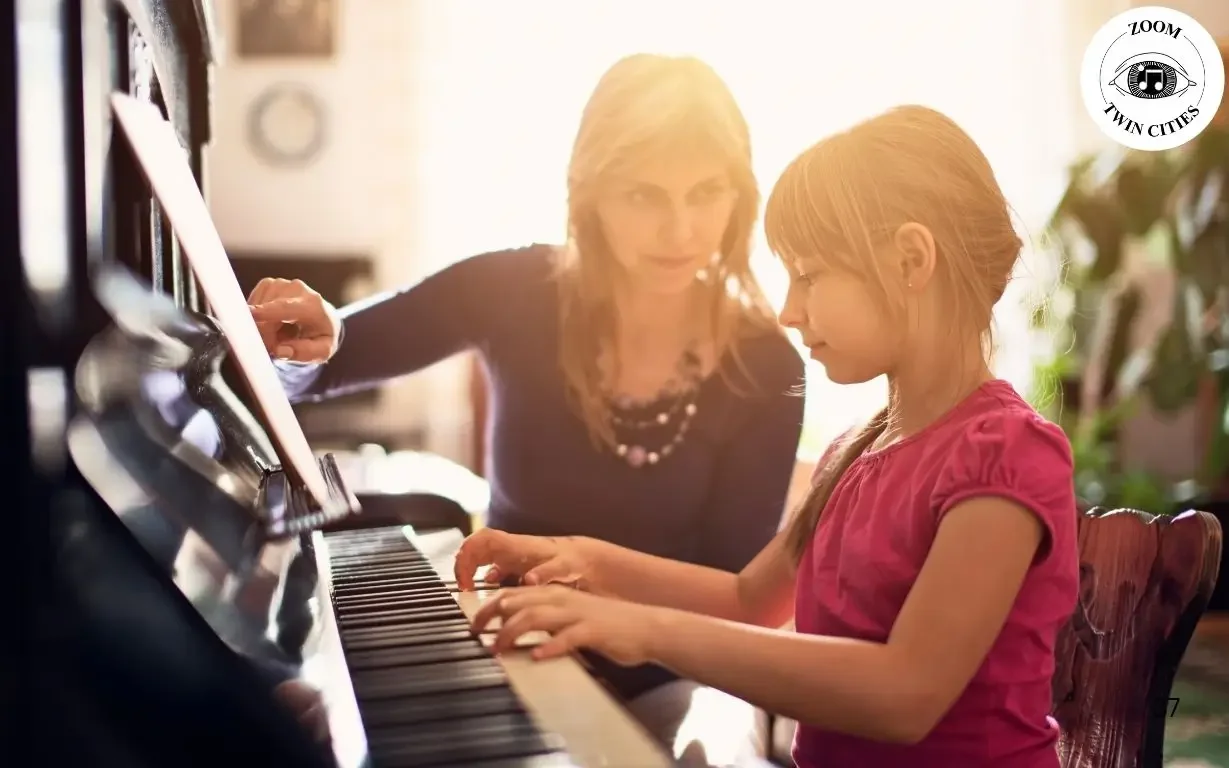
Neuroscience has made something clear: piano lessons don't just teach music. They physically change the developing brain.
Music training stimulates neuroplasticity, the brain's ability to reorganize and strengthen neural pathways in response to new learning. Structural MRI studies show that children who learn a musical instrument develop greater grey matter volume in areas responsible for motor control, auditory processing, and executive function. These differences aren't subtle. They're visible on brain scans.
What Research Says About Music and Child Development?
The evidence base for music education and brain development is substantial:
E. Glenn Schellenberg's landmark 2004 study (University of Toronto) tracked 144 children across four groups: keyboard lessons, voice lessons, drama lessons, and no lessons. After 36 weeks, children in both music groups showed significantly greater IQ gains across all tested domains.
A 2013 Harvard study found that children with musical training showed stronger structural connectivity in the corpus callosum, the bundle of nerve fibers linking the brain's two hemispheres, which is associated with better cognitive performance across multiple tasks.
Research from Northwestern University's Auditory Neuroscience Laboratory confirmed that music training strengthens the brain's ability to process sound in noisy environments, a skill directly linked to language development and academic learning.
Piano lessons are not just a nice extracurricular. They are an investment in how your child's brain grows.
Recommended Read: Why Teens Learn Music Faster Than They Think
How Does Piano Build Confidence in Children?
Confidence built at the piano isn't performance confidence alone, though that matters too.
When a child masters a piece they've been struggling with for weeks, they learn something deeper than music. They learn that persistence works. Those hard things become manageable if you break them down and keep going. Those mistakes aren't failure; they're just information about what to practice next.
Recitals, even small ones, add another layer. Standing up, playing in front of people, and receiving applause teach a child to manage nerves, present themselves, and feel proud of their effort. That kind of experience is rare and genuinely formative.
Want your child to feel that kind of confidence? Learn about Zoom Twin Cities and discover personalized lessons designed to help kids grow, learn, and shine.
Can Piano Lessons Reduce Stress and Anxiety?
Yes, piano lessons can reduce stress and anxiety, and there's real evidence for it.
Playing piano creates what psychologists call a "flow" state: full absorption in an activity that matches your skill level. In that state, anxiety decreases and mood improves naturally. It's not magic. It's just what happens when a brain is genuinely engaged with something it finds meaningful.
For children, this is especially valuable. Instead of sitting with difficult emotions they can't process or express, they have somewhere to put them. A child who's frustrated or overwhelmed can sit down at the piano and emerge fifteen minutes later noticeably calmer, not because they pushed the feelings away but because they moved through them.
The cortisol research backs this up. Multiple studies show that music-making lowers levels of the body's primary stress hormone. Piano gives children a reliable, accessible tool for managing their nervous systems, particularly useful during high-pressure stretches like exams, transitions, or big life changes.
Recommended Read: 5 Essential Exercises to Boost Your Piano Skills
Best Piano Lessons in Minnesota
If you're looking for piano lessons for your child in Minnesota, Zoom Twin Cities is the place to start.
Zoom Twin Cities offers personalized, one-on-one piano instruction designed around your child's learning pace, personality, and musical goals. Our instructors are experienced in working with children from age 4 through teen years, including beginners who've never touched a piano and advancing students ready for recitals and competitions.
What sets Zoom Twin Cities apart:
Personalized lesson plans tailored to each child's stage and learning style
Experienced, patient teachers who know how to make learning feel like play, especially in early stages
Online and in-person options so families across the Twin Cities and greater Minnesota can access quality instruction
Progress milestones that keep children motivated and parents informed
Minnesota families trust Zoom Twin Cities because they see results, not just in music, but in how their children carry themselves, handle challenges, and grow.
Our Services:
Final Thoughts
The benefits of piano lessons for children aren't vague or theoretical. They're specific, documented, and lasting: brain development, sharper focus, stronger academic performance, emotional regulation, creativity, discipline, and real confidence.
The best time to start is before the habits of distraction take root. Most children are ready between ages 4 and 7, though motivated older beginners do just as well. What matters most is consistency, personalization, and a teacher who genuinely understands how children learn.
If you're in Minnesota, you don't have to search far. Zoom Twin Cities offers exactly the kind of patient, structured, child-centered instruction that turns research-backed benefits into everyday reality for your child.
Schedule a Free Trial Lesson Today.
Frequently Asked Questions
-
Most children can begin piano lessons between ages 4 and 7, depending on attention span, hand coordination, and genuine interest in music. Some children show readiness as early as 3. A short trial lesson is the best way to assess whether your child is ready.
-
The 80/20 rule in piano means that 80% of your improvement comes from focusing on 20% of what you practice, typically the hardest sections of a piece. Rather than playing a song from beginning to end each time, skilled piano students identify the two or three measures that break down and drill those specifically until they become as easy as the rest.
-
Research suggests a correlation between music training and higher IQ scores, but it's more accurate to say that piano lessons support cognitive development in ways that show up in IQ testing. Piano doesn't guarantee a higher IQ, but consistent training does strengthen the cognitive skills that IQ tests measure.
-
Yes, multiple studies link music-making to reduced cortisol levels, the hormone most associated with stress. Children who play piano regularly have access to a reliable, structured stress-reduction tool.
-
Beginners typically benefit most from 15 to 30 minutes of focused daily practice. Shorter, consistent sessions outperform long, irregular ones.
-
Private lessons offer personalized attention, faster skill progression, and a lesson pace tailored to your child. Group lessons encourage social interaction and musical collaboration and can make early learning feel more playful. Many children start with private lessons and later enjoy ensemble or group experiences.
Recommended Read: Private vs Group Music Lessons: What Works Best?
-
Look for a teacher who communicates clearly with both the child and the parent, demonstrates genuine patience, and adapts their teaching style to how your child learns, not a one-size-fits-all method. Ask about lesson structure, how they handle a child's frustration, and how they communicate progress.