Types of Voice for Singing (Easy Guide for Beginners)
Your voice is unlike anyone else's. That's not just a motivational line; it's a biological fact. The shape of your vocal cords, the size of your resonating cavities, and your natural range all combine to create something completely unique to you.
Most beginner singers try to copy their favorite artists without knowing their own voice type first. That leads to strain, frustration, and slow progress.
Knowing your voice type changes everything. It helps you choose the right songs, train more effectively, and develop your sound faster. Whether you're just starting out or looking to sharpen your skills, this guide breaks down every type of voice for singing.
Quick Summary
There are 8 types of singing voices:
3 female (soprano, mezzo-soprano, contralto),
3 male (tenor, baritone, bass), and
2 rare male specialty types (countertenor and sopranista).
Knowing your voice type helps you pick the right songs, train smarter, and avoid strain.
To find yours, test your range when warmed up, identify your most comfortable zone, and compare it to standard vocal ranges. For the most accurate result, work with a vocal coach.
If you're in Minnesota, Zoom Twin Cities offers personalized lessons across the Twin Cities metro area.
Voice Types Explained by Genre (Pop, Rock, Opera)
Voice type classification works differently depending on the genre you're singing in.
In classical and opera, voice types follow strict rules. Your range, tone color, and weight all determine where you fit. In pop and rock, there's far more flexibility; artists often train across multiple registers and blur traditional boundaries.
Opera Voice Types and the Fach System
Opera uses a German system called Fach (pronounced "fahk") to classify singers. It goes beyond just high or low. It accounts for tone quality, vocal weight, and even the emotional character of the voice.
A dramatic soprano sounds darker and heavier than a lyric soprano, even though both sing in the same high range. A Heldentenor (heroic tenor) has the power to cut through a full orchestra. These distinctions matter in classical training.
If you're studying opera or classical vocal performance, understanding your Fach helps you choose repertoire that suits your voice, not just your ego.
Voice Types in Pop and Rock Music
Pop and rock don't use the Fach system. Artists like Billie Eilish use a lot of chest voice and a breathy low register. Freddie Mercury moved freely between baritone depth and tenor highs in the same song.
In these genres, style and technique matter more than strict classification. That said, knowing your natural voice type still helps you understand your strengths and build on them.
Recommended Read: Breathing Techniques For Singing
Exploring the Types of Voices: 8 Different Types of Singing Voices
There are eight recognized types of singing voices: Soprano, Mezzo-Soprano, Contralto, Tenor, Baritone, Bass, Counterteor, and sopranista, divided by gender and range. Each type has a distinct range, tone, and character. Here's a clear breakdown.
Female Voice Types
Female voices are generally classified into three main types: Soprano, Mezzo-Soprano, and Conralto based on their natural range.
1. Soprano
The soprano is the highest female voice type. Sopranos typically sing from middle C (C4) up to high C (C6) or beyond. In opera, the soprano is the voice of leading heroines; think Mozart's Queen of the Night.
In pop music, Mariah Carey and Céline Dion are classic examples of singers with soprano range capability. The tone is bright, clear, and carries easily over accompaniment.
2. Mezzo-Soprano
The mezzo-soprano sits in the middle of the female range, roughly A3 to A5. The tone is warmer and richer than a soprano, with more power in the mid-range.
Many pop and R&B singers naturally fall into this category. Adele is a well-known mezzo-soprano. This voice type is incredibly versatile and works well across multiple genres.
3. Contralto
The contralto is the lowest female voice type, typically ranging from E3 to E5. It's also the rarest. The sound is deep, resonant, and distinctive.
Contraltos are prized in choral music and certain operatic roles. Cher and Tracy Chapman are often cited as contralto-range singers in popular music.
Recommended Read: 10 Singing Warmup Exercise
Male Voice Types
Male voices split into three core categories, with two rare specialty types below.
4. Tenor
The tenor is the highest standard male voice, ranging roughly from C3 to C5. It's the most common male lead voice in opera, and many beloved pop male voices fall here.
Luciano Pavarotti in classical. Bruno Mars in pop. Both tenors have completely different styles. The tenor voice tends to be bright, forward, and emotionally expressive.
5. Baritone
The baritone sits between tenor and bass, typically from A2 to A4. It's the most common male voice type, meaning most men who haven't had formal training are natural baritones.
The baritone voice has a warm, full tone with natural authority. Josh Groban and Elvis Presley both had strong baritone voices with extended upper range.
Don't wait to start. The earlier you understand your voice, the faster you'll develop real, lasting skill. Book your first lesson today and finally start singing with confidence.
6. Bass
The bass is the lowest and heaviest male voice, ranging from E2 to E4. In choral and orchestral music, the bass provides the foundation. In opera, bass singers often portray kings, villains, or wise old men.
Johnny Cash is one of the most recognizable bass-range voices in popular music. The tone is dark, powerful, and commanding.
If you want private singing lessons, Zoom Twin Cities can help you.
Special Male Voice Types
There are two other special male voice types. They are:
7. Countertenor
The countertenor uses falsetto or head voice to sing in the alto or mezzo-soprano range. This is one of the rarest voice types in singing, particularly in classical music.
Countertenors like Andreas Scholl and Philippe Jaroussky have built entire careers on this extraordinary voice. The sound is pure, ethereal, and unlike anything in the standard male range.
8. Sopranista
Even rarer than the countertenor, the sopranista sings in the full soprano range using a natural physiological ability, not just trained falsetto. This voice type is exceptionally uncommon and highly sought after in early music performance.
How to Find Your Voice Type?
Finding your voice type isn't complicated, but it does require honesty about where your voice naturally sits, not where you wish it did.
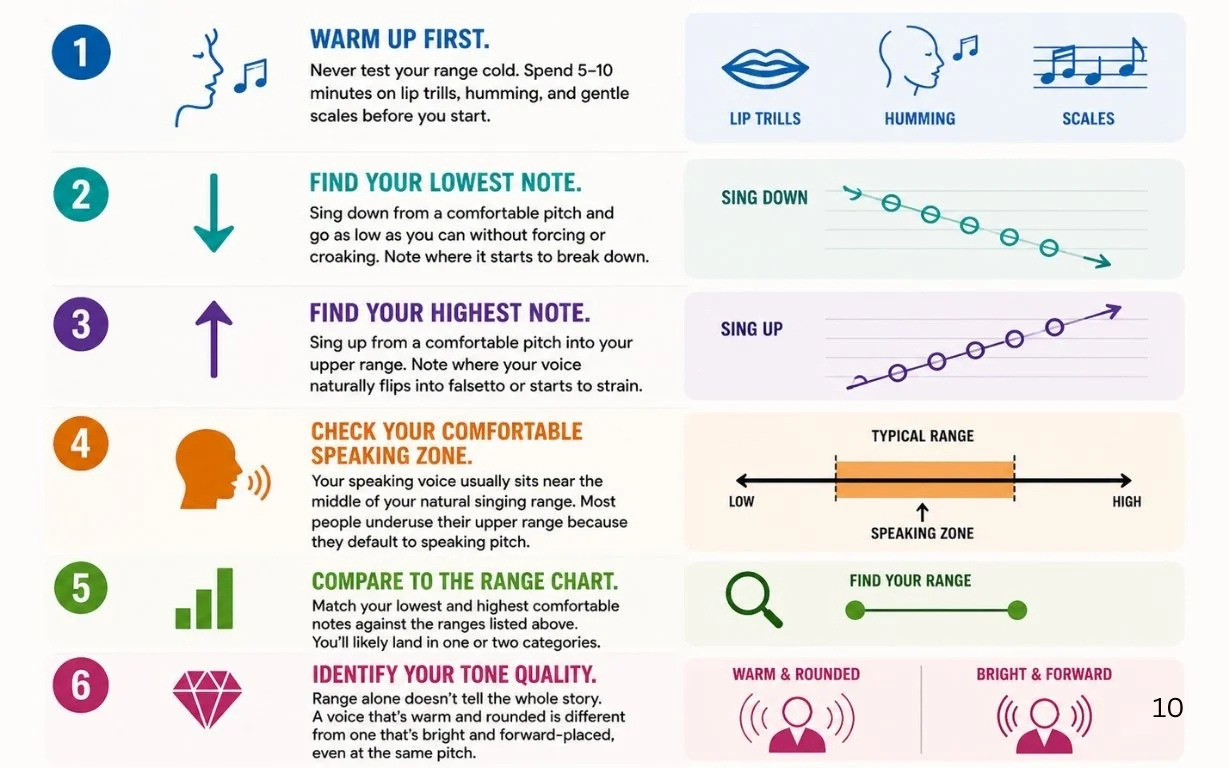
Here's a practical process:
Warm up first. Never test your range cold. Spend 5–10 minutes on lip trills, humming, and gentle scales before you start.
Find your lowest note. Sing down from a comfortable pitch and go as low as you can without forcing or croaking. Note where it starts to break down.
Find your highest note. Sing up from a comfortable pitch into your upper range. Note where your voice naturally flips into falsetto or starts to strain.
Check your comfortable speaking zone. Your speaking voice usually sits near the middle of your natural singing range. Most people underuse their upper range because they default to speaking pitch.
Compare to the range chart. Match your lowest and highest comfortable notes against the ranges listed above. You'll likely land in one or two categories.
Identify your tone quality. Range alone doesn't tell the whole story. A voice that's warm and rounded is different from one that's bright and forward-placed, even at the same pitch.
Common beginner mistakes:
Testing range when tired or sick
Forcing high notes and counting them as "real" range
Assuming they're a tenor or soprano because they like singing those songs
The most accurate classification comes from a trained vocal teacher. They can hear things in your voice you can't detect yourself, like passaggio points (where your registers shift) and resonance placement.
Recommended Read: Wondering what suits you best, private or group music lessons? Check out our Private vs. Group Music Lessons: What Works Best? guide to make the right choice.
Where in Minnesota Can I Take Singing Lessons?
If you're in the Twin Cities area and serious about vocal training, working with a qualified teacher makes all the difference.
Zoom Twin Cities offers personalized vocal training for singers at every level: beginners figuring out their voice type, intermediate singers working on range and technique, and performers preparing for auditions or recordings.
We proudly serve the broader Twin Cities metro area, including:
Shakopee
St. Louis Park
And surrounding suburbs
Our lessons are designed around your voice, not a fixed curriculum. Whether you want to sing pop, rock, musical theatre, or classical, we create a plan that fits your voice type and goals. Learn more about our singing lessons.
Our Services:
Final Thoughts
Every voice is different, and that's what makes singing so personal. Understanding your voice type, whether you're a baritone who's been straining for tenor notes or a mezzo-soprano who's been playing it too safe, is the foundation of real vocal growth.
Knowing your type helps you pick better songs, train smarter, and protect your voice from unnecessary strain.
The different types of singing voices have their strengths. None is better than another. The bass is as powerful as the soprano, just in different ways.
Ready to stop guessing and start singing with real direction? Join personalized vocal training at Zoom Twin Cities and discover exactly what your voice can do.
Book your first lesson now; spots are limited.
Frequently Asked Questions About Types of Voice for Singing
-
Yes, and no. Your basic voice type is determined by the physical size and structure of your vocal cords, which is largely genetic. However, your voice does mature and settle over time, especially through your twenties. Some singers find their true classification shifts slightly as they train and develop.
-
You can't fully change your natural voice type, but you can expand your range and improve flexibility with proper training and practice. A skilled teacher can help you develop your upper and lower limits without sacrificing tone quality or risking vocal damage.
-
The countertenor is often considered one of the rarest voice types, especially in male singers, because it requires the ability to sing very high notes with natural power and consistency. The sopranista is even rarer, though less commonly discussed in mainstream music.
-
Not at all. Every voice type is valuable. A strong bass or baritone can sound just as powerful and moving as a soprano; it depends on the song, the style, and the skill of the singer. The goal is to develop your voice, not chase someone else's range.
-
Your voice starts to settle after puberty, usually in the mid-to-late teens for most people. But the full development of tone, resonance, and stamina continues into your mid-twenties and beyond, especially with consistent training.
-
Many successful pop singers fall into the mezzo-soprano or tenor category because those ranges handle both mid-range verses and high choruses naturally. That said, every voice type has representation in pop music. Your genre fit depends more on style and technique than classification.
-
With regular practice and proper guidance, you can hear noticeable improvements in a few weeks. Building strong, reliable technique takes months of consistent training. Working with an experienced vocal coach dramatically speeds up that process by keeping you on the right path from the start.