How to Improve Your Singing Voice at Home: 7 Exercises That Actually Work
Singing isn't just something you're born knowing how to do. It's a skill, and like any skill, it gets better the more you work at it.
A lot of professional singers started exactly where you are right now: struggling with breath control, singing off-key, or feeling too self-conscious to even try. What changed things for them wasn't some magical talent that suddenly appeared. It was showing up every day, warming up properly, and building good habits over time.
The good news? You don't need a fancy studio or expensive lessons to start improving. With the right exercises and a little consistency, you can develop a stronger, clearer, more confident voice, right from your living room.
This guide walks you through simple vocal exercises that actually work for beginners. You'll learn how to breathe properly for singing, protect your voice from strain, and follow a daily practice routine that fits into a busy schedule.
If you want personalized expert guidance to improve your singing voice faster, Zoom Twin Cities can help.
Quick Overview
Singing is a learnable skill that gets better with daily, intentional practice.
Warming up your voice before singing protects your vocal cords and prevents unnecessary strain.
Simple at-home exercises can make a real difference in your pitch, breath control, and overall confidence.
Lip trills and humming help your voice relax and sound more natural.
Breathing from your diaphragm gives your voice more power and helps you hold notes longer.
Practicing scales trains your ears and your voice to work together.
Sirens are one of the gentlest ways to expand your vocal range.
Releasing jaw and facial tension helps your voice come out cleaner and more freely.
Sustained vowel exercises build the kind of vocal stability that makes songs sound polished.
A 15–20 minute daily session is honestly all most beginners need to see real progress.
Drinking enough water and knowing when to rest are just as important as the exercises themselves.
Recording yourself, even though it feels awkward, is one of the fastest ways to improve.
Why Do You Need to Warm Up Your Voice?
Vocal warm-ups get your airways open, loosen up tension you might not even realize you're carrying, and help your voice move more freely between notes. Skip them, and you might notice tightness, unexpected cracking, or that frustrating feeling of your throat working against you.
Even just 5–10 minutes of warming up can completely change how your voice feels and sounds during practice. It's a small habit with a surprisingly big payoff.
Good warm-ups help you
Let go of throat tension
Move between notes more flexibly
Control your airflow better
Hit higher notes without straining
Keep your voice healthy long-term
7 Singing Exercises That Will Actually Improve Your Voice
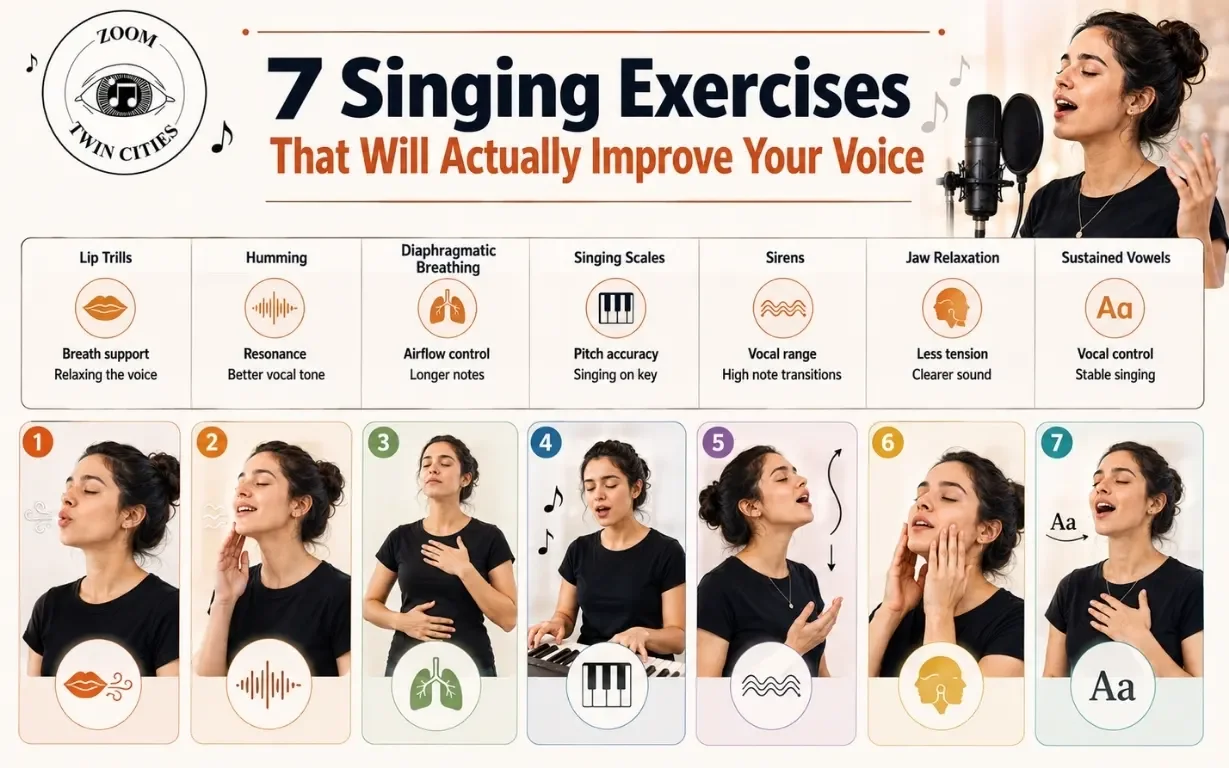
The fastest path to a better singing voice isn't grinding through songs for hours; it's targeted daily practice that trains the specific things holding you back: breath support, pitch, resonance, and control. These seven singing exercises are beginner-friendly.
| Exercise | Main Benefit | Best For |
|---|---|---|
| Lip Trills | Breath support | Relaxing the voice |
| Humming | Resonance | Better vocal tone |
| Diaphragmatic Breathing | Airflow control | Longer notes |
| Singing Scales | Pitch accuracy | Singing on key |
| Sirens | Vocal range | High note transitions |
| Jaw Relaxation | Less tension | Clearer sound |
| Sustained Vowels | Vocal control | Stable singing |
1. Lip Trills for Breath Support
Lip trills are one of the best singing exercises at home for beginners.
All you do is blow air through loosely closed lips while making a sound, kind of like a motorboat or a drawn-out "brrr." It feels a little ridiculous at first. Do it anyway.
Benefits of lip trills:
Trains your breath support from the ground up
Relaxes your vocal cords naturally
Reduces the risk of strain
Makes transitions between notes feel smoother
Spend 2–3 minutes on this before you start singing anything else. It makes a noticeable difference.
2. Humming for Better Resonance
Humming builds vocal resonance and improves tone quality.
Close your mouth and hum softly. Pay attention to where you feel vibrations: your lips, cheeks, and nose. That buzzing sensation is your resonance at work, and it's what gives a voice warmth, depth, and carrying power.
Humming teaches you to project your voice without forcing volume. It's gentle, it's effective, and it's something you can literally do while making tea or walking around the house.
Recommended Read: Best Age to Learn Singing
3. Diaphragmatic Breathing
Many beginners breathe from their chest instead of the diaphragm.
Chest breathing creates weak airflow and causes singers to run out of breath quickly. Diaphragmatic breathing pulls air deeper, expands your lung capacity, and gives your voice a much more solid foundation.
Try this:
Put one hand on your stomach
Breathe in slowly through your nose
Feel your belly push outward (not your chest)
Exhale slowly while making a soft "sss" sound
If your hand moves out when you inhale, you're doing it right. If your shoulders rise instead, keep practicing; it takes a little time to unlearn old habits.
4. Singing Scales for Pitch Accuracy
Singing off-key is one of the most common beginner struggles, and scales are the most reliable fix.
"Do re mi fa sol" might feel like something from a kids' movie, but it's genuinely one of the best tools for training your ear and your voice to hit notes accurately. Use a piano app or a simple keyboard, go slowly, and focus on matching each note cleanly rather than rushing through.
It's less exciting than singing an actual song, but the improvement you'll hear in your pitch over a few weeks makes it completely worth it.
5. Sirens for Expanding Your Range
Siren is the exercise that makes reaching higher notes feel less terrifying.
Make an "oo" sound and slide your voice smoothly from your lowest comfortable note all the way up to your highest and then back down, like an actual siren. The goal is a smooth, connected glide with no jumping or cracking between registers.
This exercise works because it trains your voice to transition naturally between chest voice and head voice, which is where a lot of cracking happens for beginners.
One important rule: never force the top of the siren. If a note feels strained, back off. The whole point is to build range gradually, not push through tension.
Curious about what Zoom Twin Cities singing lessons have to offer? Visit Zoom Twin Cities Singing Lessons today and explore personalized vocal coaching designed for singers of all skill levels.
6. Jaw and Facial Relaxation
This one often gets skipped, but it matters more than people think.
Tension in your jaw, cheeks, or face creates a kind of invisible ceiling on your sound. It makes singing feel like hard work and often makes your voice sound tighter and less open than it could be.
Some simple things to try:
Slowly open and close your jaw a few times
Gently massage your cheeks and jawline
Stretch your facial muscles (yes, it looks weird — do it anyway)
Let yourself yawn naturally to open up the throat
Loose muscles equal a freer sound. It's that simple.
Recommended Read: What are the Types of Voice for Singing?
7. Sustained Vowels for Vocal Control
This exercise is all about steadiness.
Pick a vowel, "ah" or "ee"; both work well, and hold it for as long as you can while keeping the sound smooth, even, and controlled. No wobbling, no fading in and out, no rushing.
Focus on:
Keeping your airflow steady throughout
Holding the pitch without drifting
Maintaining a clear, open tone
Breathing in a way that supports the note rather than fights it
If your notes tend to shake or trail off, this exercise will help more than almost anything else.
A Daily Singing Routine for Beginners
Here's a truth that might save you a lot of frustration: 15–20 focused minutes every day will get you further than a two-hour session once a week.
Vocal progress comes from repetition. Your vocal muscles, like any other muscles, strengthen through consistent, repeated use. The routine doesn't have to be long. It just has to happen regularly.
A Simple 15-Minute Daily Routine
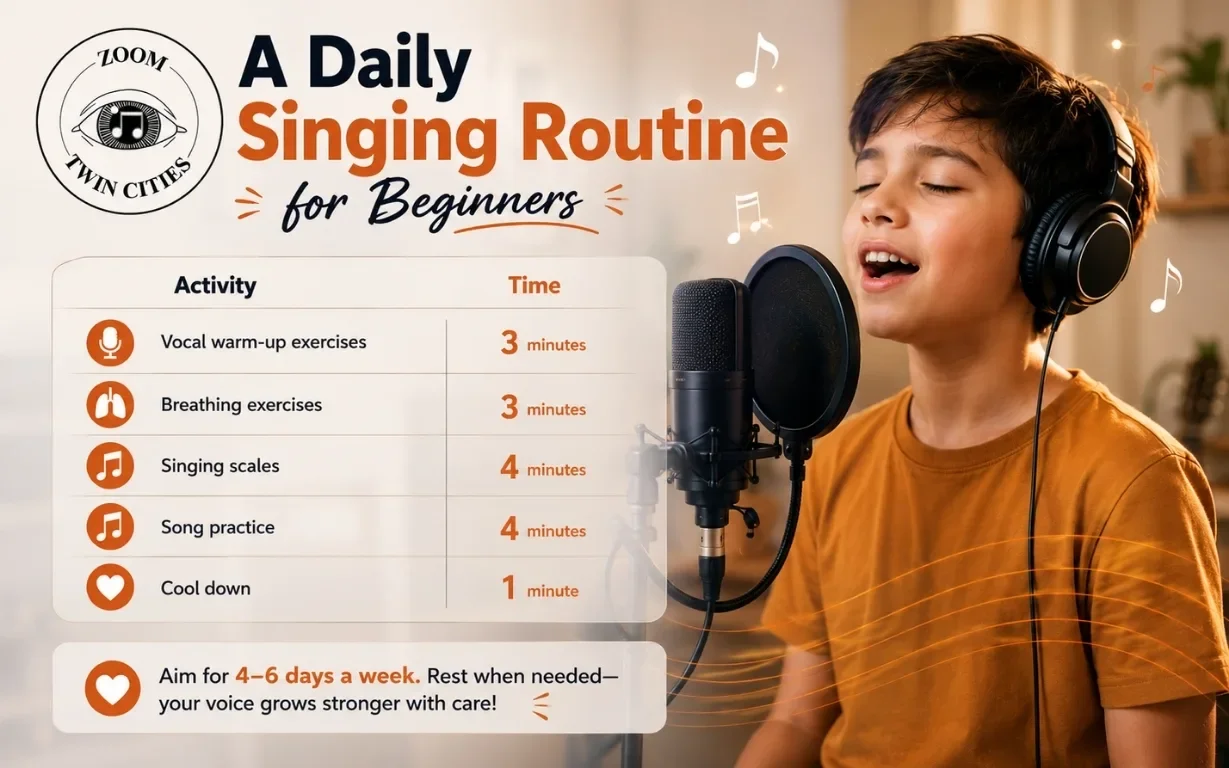
| Activity | Time |
|---|---|
| Vocal warm-up exercises | 3 minutes |
| Breathing exercises | 3 minutes |
| Singing scales | 4 minutes |
| Song practice | 4 minutes |
| Cool down | 1 minute |
Aim for 4–6 days a week. If your throat feels tired or sore, that's your body telling you to rest, and rest is actually part of the process. Your voice recovers and strengthens during downtime too.
How to Improve Your Singing Voice Without Hurting It?
Many beginners accidentally work against themselves by practicing in ways that create tension and strain instead of progress. Knowing what not to do is just as valuable as knowing the right exercises.
Common Mistakes That Slow You Down
Watch out for these:
Singing too loudly too soon: volume isn't the goal; control is
Skipping your warm-up: even on days when you're in a rush
Slouching or tensing your shoulders: posture affects airflow more than most people realize
Singing from your throat: your power should come from your breath, not your neck
Forcing high notes: if it feels strained, it probably is
Practicing until it hurts: soreness is a signal, not a badge of honor
What You Eat and Drink Matters Too
Your voice is part of your body, and your body runs on what you put into it.
Things that genuinely help:
Warm water (your best friend as a singer)
Herbal tea
Hydrating fruits like watermelon or oranges
A little honey if your throat feels irritated
Things worth limiting before a practice session:
Caffeine (dries out your throat)
Very cold drinks (can tighten the vocal cords)
Dairy in large amounts (can increase mucus for some people)
Building Breath Control and Diaphragm Strength
Strong singing is really just controlled breathing with sound on top.
When your breath support is solid, everything gets easier; you can hold notes longer, sing louder without straining, and maintain pitch without wobbling. When it's weak, you'll feel like you're constantly running out of steam.
How to Tell if You're Using Your Diaphragm
Signs you're on the right track:
Your belly expands when you breathe in
Your shoulders stay mostly relaxed and still
Airflow feels consistent and easy
Notes feel supported rather than squeezed out
If your shoulders are doing most of the work when you inhale, you're still chest breathing. Keep practicing the belly breathing technique until it starts to feel more natural.
A Simple Exercise for Longer Notes
Try this breathing drill:
Inhale slowly for 4 counts
Hold for 4 counts
Exhale as slowly as you can for 8 counts
Repeat 4–5 times
It's simple, but done consistently, it builds real stamina for holding phrases and singing through longer passages without gasping.
Tracking Your Progress at Home
One of the most powerful things you can do as a self-taught singer is also one of the most uncomfortable: record yourself.
Nobody likes hearing their own voice on a recording at first. It sounds different from what you hear in your head, and that gap can feel discouraging. But that gap is actually the point, recordings capture your external voice, which is what everyone else hears. Learning to listen to it objectively is how you catch problems you can't notice while you're in the middle of singing.
What to Listen for in Your Recordings
Are you hitting notes accurately or drifting sharp/flat?
Is your breathing audible or choppy?
Are your words coming through clearly?
Is your timing steady?
Compare recordings from a few weeks apart, and you'll almost certainly notice improvement you didn't even realize was happening. It's a genuinely encouraging experience once you get past the initial awkwardness.
Recommended Read: Boost Confidence with Private Singing Lessons
Singing Lessons with Zoom Twin Cities in Minnesota
Some people make great progress practicing on their own. Others hit a wall and realize they'd improve a lot faster with someone in their corner.
Zoom Twin Cities offers beginner-friendly singing lessons built around the things that actually matter: breath control, pitch improvement, vocal confidence, and learning to sing in a way that's healthy for your voice long-term.
Working with a vocal coach means:
Someone catches and corrects your mistakes before they become habits
You improve faster because your practice has clear direction
You build confidence in a supportive, low-pressure environment
Your vocal range grows safely, without pushing past your limits
You develop technique that protects your voice for years to come
If you've been practicing on your own and feel like you've hit a plateau, structured feedback might be exactly what you need. Contact Zoom Twin Cities today to explore personalized vocal coaching designed to help you grow with confidence.
Final Thoughts
Improving your singing voice at home is absolutely possible, but it takes patience, consistency, and a willingness to show up even on the days when your voice doesn't cooperate.
You're not going to sound like your favorite artist overnight. But if you practice the right things regularly, take care of your voice, and stay curious about your own progress, you'll be genuinely surprised at how much you can improve.
Some days will feel great. Others will feel like you're going backward. Both are completely normal. Keep practicing anyway.
And if you want a little more structure and support along the way, beginner coaching with Zoom Twin Cities is a great next step.
Frequently Asked Questions
-
You can improve your singing voice naturally through consistent practice, breathing exercises, vocal warm-up exercises, and healthy vocal habits. Daily singing exercises at home help strengthen breath support, pitch control, and vocal confidence over time.
-
Yes, singing may help reduce cortisol, which is the body’s stress hormone. Many studies show that singing can improve mood, reduce stress, and help people feel more relaxed emotionally and physically.
-
The four common voice types are soprano, alto, tenor, and bass. Soprano and alto are usually higher voices, while tenor and bass are lower voices. Each voice type has its own natural range and tone quality.
-
Yes, poor singing technique can strain or damage the vocal cords. Shouting, forcing high notes, skipping vocal warm-up exercises, and over-practicing increase the risk of vocal strain. Healthy technique and proper rest help protect your voice.
-
Recorded singing sounds different because recordings capture your external voice rather than the sound vibrations you hear inside your head. Listening to recordings helps improve pitch awareness and vocal control over time.
-
Practice breath support, vocal sirens, and relaxed transitions between chest voice and head voice. Avoid pushing or shouting high notes because tension often causes cracking.
-
Chest voice feels fuller and stronger in lower notes, while head voice feels lighter and is used for higher notes. Learning to balance both helps singers improve flexibility and vocal range.
-
Yes, adults can absolutely learn to sing well. Consistent vocal exercises for beginners, proper breathing techniques, and regular practice help singers improve at almost any age.
-
You should consider a vocal coach if you struggle with pitch, vocal strain, confidence, or slow progress. Professional guidance helps correct mistakes early and creates a structured learning path.